Waterfowl
Ruddy shelduck
tadorna ferruginea
IUCN Red ListLeast Concern
Audio guide
Listen to the story of this animal
0:000:00
Ruddy shelduck
- Description
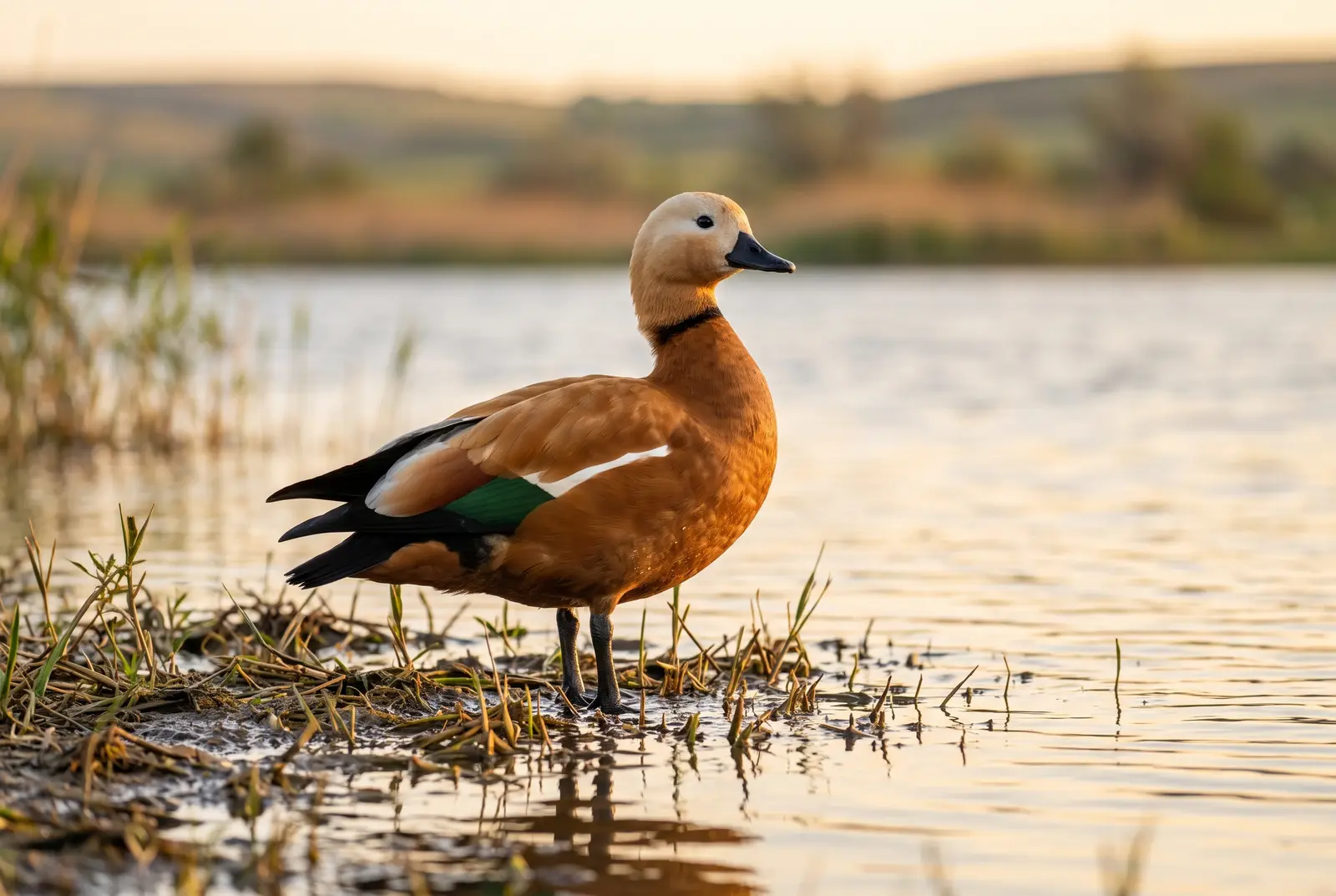
- The ruddy shelduck is a striking, goose-like duck that sits between true ducks and geese. It measures 58–70 cm and weighs about 1–1.6 kg. The body is a warm rusty-orange (cinnamon) with a much paler, creamy-buff head, a black tail and black flight feathers, and a bold white wing patch set off by a metallic green speculum. In the breeding season the male shows a thin black collar, while the female has a whiter face and no collar. The bill and legs are black.
- Habitat
- It favours open country with fresh or salty lakes, rivers and steppe pools, keeping clear of dense forest and sea coasts. It climbs remarkably high — on Tibetan lakes it breeds above 4,500 m. Its range runs from southeastern Europe through Turkey and Central Asia to Mongolia and China, with isolated populations in northwest Africa and Ethiopia.
- Diet
- An omnivore with a plant-based bias, it grazes grass and fresh shoots and gathers seeds, grain and water plants, topping up its diet with invertebrates, insects, molluscs, crustaceans and other small animals. It often forages on foot across dry land.
- Reproduction
- Pairs are strongly bonded and long-lasting, forming on the wintering grounds. Nests are hidden in burrows, rock crevices, tree holes or ruined buildings, often well away from water. The female lays around 8 (6–12) eggs and incubates them alone for about 28–30 days while the male stands guard. Both parents lead the ducklings, which fledge at roughly 55 days.
- Lifespan
- Around 13 years in the wild, and over 20 years in human care.
- Did you know?
- In Tibetan Buddhism the ruddy shelduck is a sacred bird and a symbol of faithfulness, as pairs stay together for life. It is also one of the highest-flying birds and has been recorded crossing the Himalayas.
Homeland & habitat
Where the ruddy shelduck lives
Spin the globe to see where the species comes from and where it lives today.
Central Asia and southeastern EuropeThe ruddy shelduck breeds on steppe lakes and rivers from southeastern Europe across Central Asia to Mongolia and China, with isolated populations in North Africa and Ethiopia.
Loading globe…
Native rangeIntroduced / also today
Drag to rotate · double-click to recentre on the homeland
10 facts about the ruddy shelduck
The cards keep rotating — hover with your mouse to pause them.
- GroupWaterfowlvrubozobí (Anseriformes) · kachnovití (Anatidae)
- Scientific nametadorna ferrugineaLatin name of the species
- Homeland & habitatObývá otevřenou krajinu se sladkými i slanými jezery, řekami a stepními tůněmi, přičemž se vyhýbá hustým lesům a mořskému pobřeží. Vystupuje pozoruhodně vysoko do hor – na tibetských jezerech hnízdí i nad 4 500 m n. m. Areál se táhne od jihovýchodní Evropy přes Turecko a Střední Asii po Mongolsko a Čínu, s izolovanými populacemi v severozápadní Africe a Etiopii.
- DietJe všežravec s převahou rostlinné stravy. Spásá trávu a mladé výhonky, sbírá semena, obilí i vodní rostliny a doplňuje je bezobratlými, hmyzem, měkkýši, korýši a dalšími drobnými živočichy. Za potravou často chodí pěšky po souši.
- ReproductionTvoří pevné, dlouholeté páry, které se utvářejí už na zimovištích. Hnízdí ukrytě – v norách, skalních štěrbinách, dutinách stromů či opuštěných stavbách, klidně i daleko od vody. Samice snáší zpravidla 8 (6–12) vajec a sama je zahřívá asi 28–30 dní, zatímco samec hlídá okolí. O vyvedená mláďata pečují oba rodiče; létat začínají kolem 55 dnů.
- LifespanV přírodě se dožívá kolem 13 let, v lidské péči i přes 20 let.
- Conservation statusLeast ConcernAccording to the IUCN Red List
- Did you know…?V tibetském buddhismu je husice rezavá posvátným ptákem a symbolem věrnosti – páry spolu drží celý život. Patří také k nejvýše létajícím ptákům a byla pozorována při přeletu Himálaje.
- Where in the zooArea A — the water-lily pond
- How many we keep♂ 2 · ♀ 2total: 4
Conservation status
Species vulnerability index
Least Concern
Near Threatened
Vulnerable
Endangered
Critically Endangered
Support the care of our animals
A symbolic adoption contributes to feeding, veterinary care and the development of the exhibits — and you get a certificate and updates about your animal.
Browse adoptions