Waterfowl
Bar-headed goose
anser indicus
IUCN Red ListLeast Concern
Audio guide
Listen to the story of this animal
0:000:00
Bar-headed goose
- Description
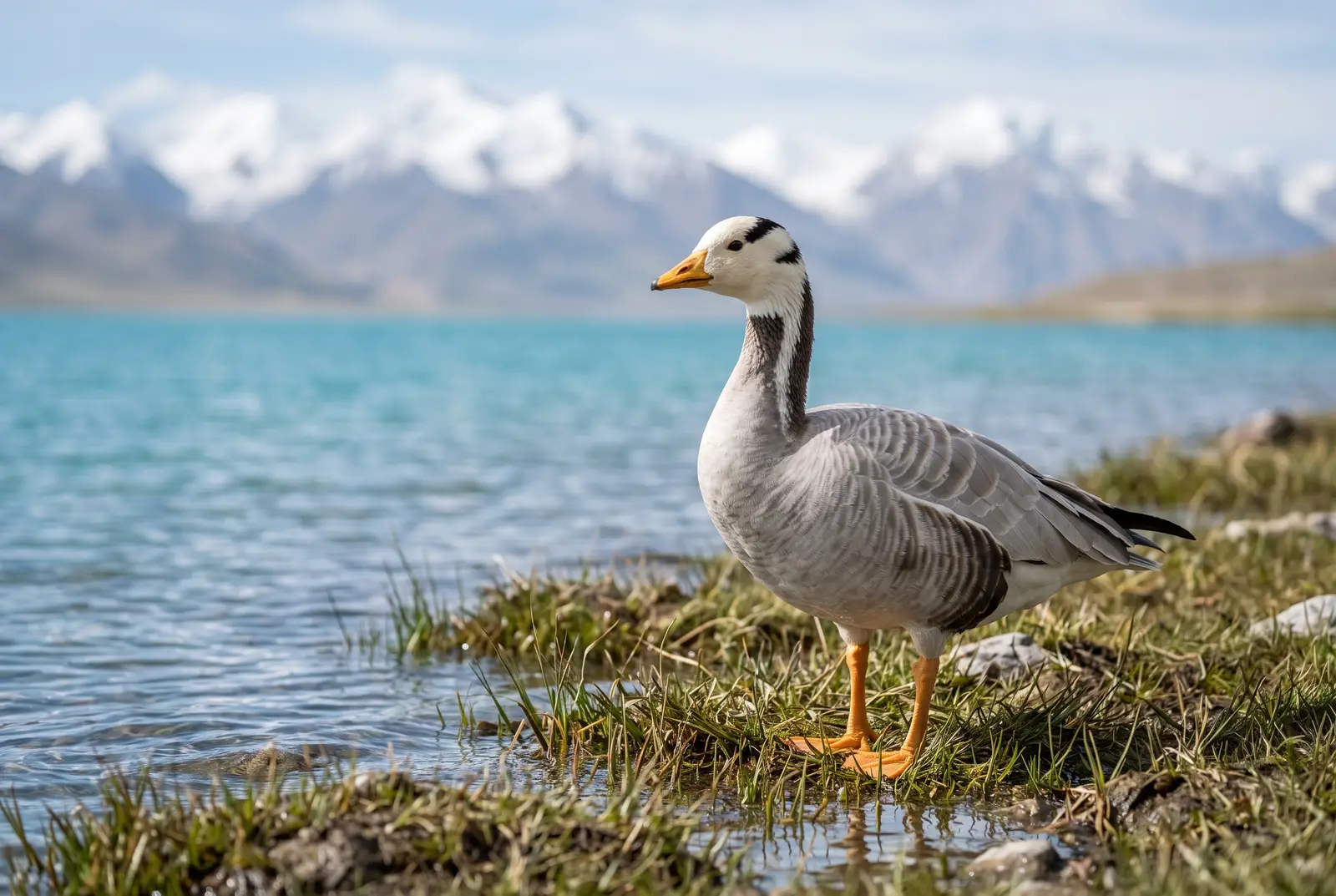
- The bar-headed goose is a slim, pale grey goose about 71–76 cm long and weighing roughly 2–3 kg. It is unmistakable thanks to its white head crossed by two black bars on the nape, which give the bird its name. The bill and legs are orange-yellow, and the flanks are marked with delicate grey-and-white barring. Its call is a soft, nasal honk that carries far across open country.
- Habitat
- It breeds on high-altitude lakes, marshes and rivers across Central Asia – on the Tibetan Plateau and in Mongolia, Kyrgyzstan and neighbouring parts of China and India, often above 4,000 metres. For the winter it migrates to the lowlands of South Asia, mainly India, Pakistan, Bangladesh and Myanmar, where it gathers on lakes, rivers and flooded fields.
- Diet
- The bar-headed goose is almost entirely herbivorous. It grazes on grasses, sedges and other green plants, takes aquatic vegetation from the water, and on its wintering grounds feeds on barley, rice and fresh shoots in flooded fields. Its short, strong bill also lets it pull up roots and tubers.
- Reproduction
- It nests colonially on the ground close to water, often on islands that are safe from predators. The female usually lays 3–8 eggs and incubates them for about 27–30 days. Both parents care for the newly hatched goslings, and the family stays together until the young can fly.
- Lifespan
- In the wild the bar-headed goose usually lives around 10–15 years, while in human care, with plenty of food and safety, it can reach more than 20 years.
- Did you know?
- The bar-headed goose is one of the highest-flying birds in the world: on migration it crosses the ridges of the Himalayas and has been recorded above 7,000 metres, where the air is so thin that most birds could not even take off. It manages this thanks to a special form of haemoglobin that binds oxygen far more efficiently than in other geese.
Homeland & habitat
Where the bar-headed goose lives
Spin the globe to see where the species comes from and where it lives today.
High-altitude lakes of Central AsiaThe bar-headed goose breeds on the high-altitude lakes of Central Asia and migrates to the lowlands of South Asia for the winter.
Loading globe…
Native rangeIntroduced / also today
Drag to rotate · double-click to recentre on the homeland
10 facts about the bar-headed goose
The cards keep rotating — hover with your mouse to pause them.
- GroupWaterfowlvrubozobí (Anseriformes) · kachnovití (Anatidae)
- Scientific nameanser indicusLatin name of the species
- Homeland & habitatHnízdí na vysokohorských jezerech, mokřadech a řekách Střední Asie – na Tibetské náhorní plošině, v Mongolsku, Kyrgyzstánu a přilehlých oblastech Číny a Indie, často v nadmořských výškách nad 4 000 metrů. Na zimu se stěhuje do nížin jižní Asie, zejména do Indie, Pákistánu, Bangladéše a Barmy, kde přezimuje na jezerech, řekách a zaplavených polích.
- DietJe téměř výhradně býložravá. Spásá trávu, ostřice a další zelené rostliny, ve vodě sbírá vodní byliny a na zimovištích si pochutnává na obilí, rýži a mladých výhoncích na zaplavených polích. Krátkým silným zobákem dokáže vytrhávat i kořínky a hlízy.
- ReproductionHnízdí koloniálně na zemi poblíž vody, nejraději na ostrůvcích chráněných před šelmami. Samice snáší zpravidla 3–8 vajec a sedí na nich přibližně 27–30 dní. O čerstvě vylíhlá house pečují oba rodiče a rodina drží pohromadě až do doby, než mláďata vzlétnou.
- LifespanVe volné přírodě se husa indická dožívá zpravidla kolem 10–15 let, v lidské péči při dostatku potravy a bezpečí i přes 20 let.
- Conservation statusLeast ConcernAccording to the IUCN Red List
- Did you know…?Husa indická patří mezi nejvýše létající ptáky světa – při tahu překonává hřebeny Himálaje a byla zaznamenána ve výškách přes 7 000 metrů, kde je vzduch tak řídký, že by většina ptáků vůbec nevzlétla. Umožňuje jí to zvláštní hemoglobin, který váže kyslík mnohem účinněji než u ostatních hus.
- Where in the zooArea A — the water-lily pond
- How many we keep♂ 1 · ♀ 1total: 2
Conservation status
Species vulnerability index
Least Concern
Near Threatened
Vulnerable
Endangered
Critically Endangered
Support the care of our animals
A symbolic adoption contributes to feeding, veterinary care and the development of the exhibits — and you get a certificate and updates about your animal.
Browse adoptions