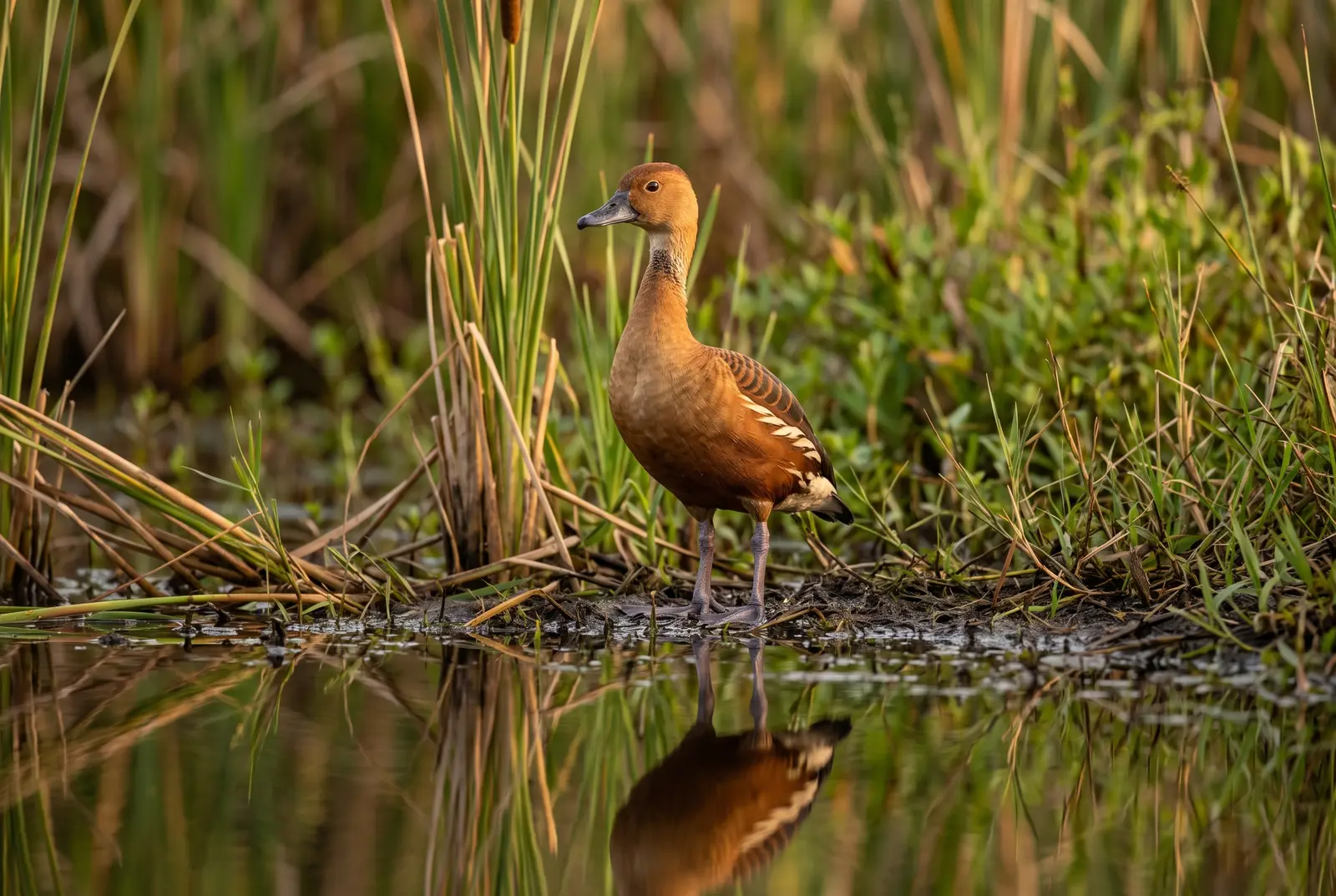
Waterfowl
Fulvous whistling duck
dendrocygna bicolor
IUCN Red ListLeast Concern
Audio guide
Listen to the story of this animal
0:000:00
Fulvous whistling duck
- Description
- The fulvous whistling duck is a slender, long-legged duck with warm cinnamon-brown plumage that gives it its name. It measures around 45–53 cm and weighs 600–1000 g. Its trademarks are the creamy-white flank stripes, a dark back edged with buff, and a fine dark line running down the nape. Both sexes look almost identical, and its upright stance makes it resemble a small goose more than a typical duck.
- Habitat
- It favours freshwater wetlands, shallow lakes, flooded meadows and above all rice fields across the tropics of three continents. It seeks calm, densely vegetated water that offers both food and cover. As one of the most widespread of all waterfowl, it lives in the Americas, sub-Saharan Africa and the Indian subcontinent.
- Diet
- Its diet is largely plant-based – mainly grass and rice seeds, the green parts of aquatic plants, and some invertebrates. It forages mostly at dusk and through the night, often flying out to nearby fields, and will even dive for food.
- Reproduction
- Pairs are long-term and monogamous, and both parents share incubation and duckling care – something quite rare among ducks. The nest is hidden in dense waterside vegetation, with a typical clutch of 12–14 eggs. Several females sometimes lay in a single nest, producing enormous communal clutches. Incubation lasts about 24–26 days, and the ducklings are active from the moment they hatch.
- Lifespan
- In the wild it usually lives around 6–10 years, and considerably longer in human care – exceptionally up to about 20 years.
- Did you know?
- Despite being a duck, it does not quack but gives a clear, melodic whistle – the very trait behind the name 'whistling duck.'
Homeland & habitat
Where the fulvous whistling duck lives
Spin the globe to see where the species comes from and where it lives today.
Tropics of the Americas, Africa and South AsiaOne of the world's most widespread ducks, it inhabits tropical wetlands across the Americas, sub-Saharan Africa and South Asia.
Loading globe…
Native range
Drag to rotate · double-click to recentre on the homeland
10 facts about the fulvous whistling duck
The cards keep rotating — hover with your mouse to pause them.
- GroupWaterfowlvrubozobí (Anseriformes) · kachnovití (Anatidae)
- Scientific namedendrocygna bicolorLatin name of the species
- Homeland & habitatObývá sladkovodní mokřady, mělká jezera, zaplavené louky a zejména rýžová pole v tropech tří kontinentů. Vyhledává klidnou vodu hustě zarostlou vegetací, která jí poskytuje potravu i úkryt. Patří k nejrozšířenějším vrubozobým vůbec – žije v Americe, subsaharské Africe i na indickém subkontinentu.
- DietŽiví se převážně rostlinnou stravou, hlavně semeny trav a rýže, zelenými částmi vodních rostlin a v menší míře bezobratlými. Potravu sbírá nejčastěji za soumraku a v noci, kdy se vydává i na okolní pole, a za sousty se dokáže i potápět.
- ReproductionTvoří dlouhodobé monogamní páry, přičemž na inkubaci i vodění mláďat se podílejí oba rodiče – u kachen poměrně vzácný jev. Hnízdo ukrývá do husté vegetace u vody a snůška čítá zpravidla 12–14 vajec. Občas do jednoho hnízda snáší víc samic, takže vznikají obří společné snůšky. Inkubace trvá zhruba 24–26 dní a kachňata jsou od vylíhnutí velmi čilá.
- LifespanVe volné přírodě se dožívá zhruba 6–10 let, v lidské péči i výrazně déle, výjimečně kolem 20 let.
- Conservation statusLeast ConcernAccording to the IUCN Red List
- Did you know…?Přestože se jí říká husička, není to husa – patří mezi takzvané husičky neboli pískavé kachny, které místo kváku vydávají melodické hvízdání.
- Where in the zooArea A — the water-lily pond
- How many we keep♂ 5 · ♀ 5total: 10
Conservation status
Species vulnerability index
Least Concern
Near Threatened
Vulnerable
Endangered
Critically Endangered
Support the care of our animals
A symbolic adoption contributes to feeding, veterinary care and the development of the exhibits — and you get a certificate and updates about your animal.
Browse adoptions