Farm animals
Valais Blacknose Sheep
Ovis aries
Species originDomesticated
Audio guide
Listen to the story of this animal
0:000:00
Valais Blacknose Sheep
- Description
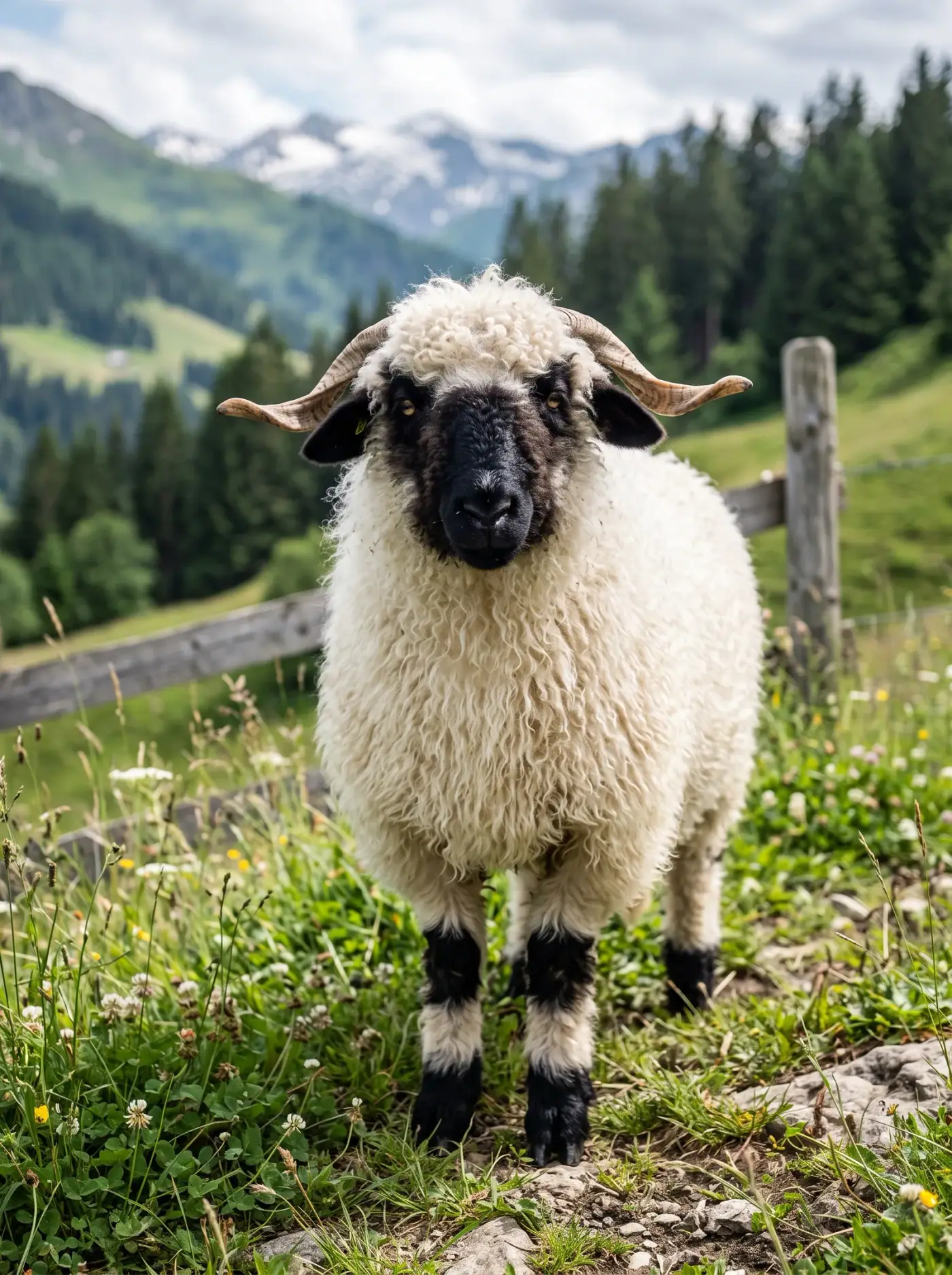
- A traditional Swiss mountain breed instantly recognisable for its striking pattern: a snow-white, dense woolly coat contrasting with a jet-black nose, ears, knees and feet. Both rams and ewes carry spiralled horns and grow long, coarse wool. Rams reach roughly 80-100 kg and ewes 70-80 kg, giving the breed a sturdy, robust build.
- Habitat
- This is a domestic breed rather than a wild animal. It originated in the mountainous Valais canton of southern Switzerland, where it has been kept since at least the 15th century and was officially recognised as a breed in 1962. It is superbly adapted to cold, rugged Alpine terrain and grazes happily on steep, stony pastures.
- Diet
- A grazing herbivore, it feeds on grass, hay and the leaves of shrubs, and is sometimes given mineral supplements to keep it healthy on sparse mountain forage.
- Reproduction
- Ewes carry their lambs for about 150 days and usually give birth to one lamb, occasionally twins. The breed can lamb twice within roughly two years.
- Lifespan
- Typically around 10-12 years.
- Did you know?
- With its fluffy coat and cartoon-like black face, the Valais Blacknose is often nicknamed "the world's cutest sheep" and is a favourite subject for photographers.
Homeland & habitat
Where the valais blacknose sheep lives
Spin the globe to see where the species comes from and where it lives today.
Valais, SwitzerlandA domestic sheep breed originating in the mountainous valleys of the Valais canton in southern Switzerland, now also kept elsewhere in Europe and North America.
Loading globe…
Native rangeIntroduced / also today
Drag to rotate · double-click to recentre on the homeland
10 facts about the valais blacknose sheep
The cards keep rotating — hover with your mouse to pause them.
- GroupFarm animalsArtiodactyla (sudokopytníci) · Bovidae (turovití)
- Scientific nameOvis ariesLatin name of the species
- Homeland & habitatHornaté oblasti Švýcarska – Valaiské údolí.
- DietTráva, seno, listy keřů, případně minerální doplňky.
- ReproductionBřezost 150 dní
- Lifespan10–12 let
- Conservation statusDomesticatedA domesticated form — not found in the wild
- Did you know…?Plemeno je známé pro svou „plyšovou“ a fotogenickou podobu – často je označováno za nejkrásnější ovci světa.
- Where in the zooArea A — the farm animal yard
- How many we keep♂ 1 · ♀ 2total: 3
Support the care of our animals
A symbolic adoption contributes to feeding, veterinary care and the development of the exhibits — and you get a certificate and updates about your animal.
Browse adoptions