Birds
Silver Pheasant
Lophura nycthemera
IUCN Red ListLeast Concern
Audio guide
Listen to the story of this animal
0:000:00
Silver Pheasant
- Description
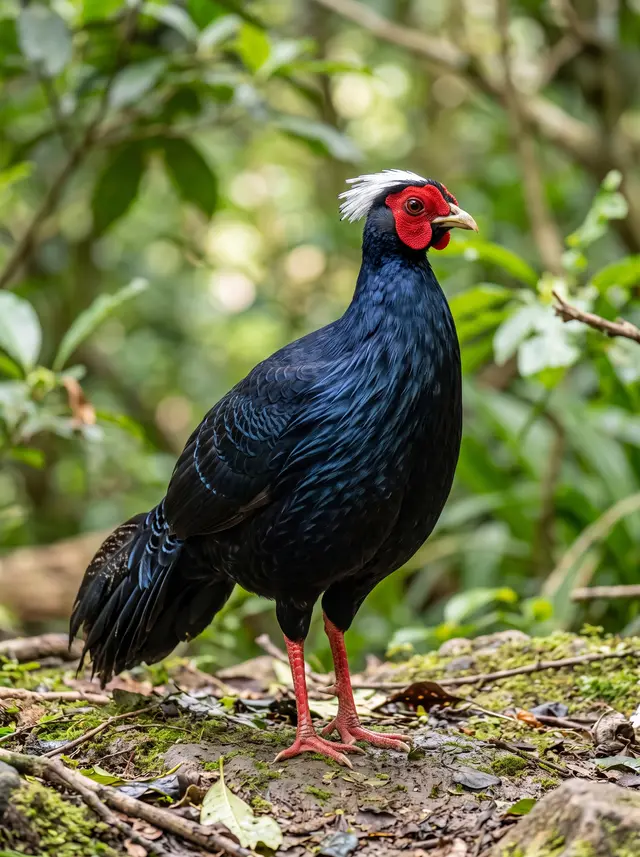
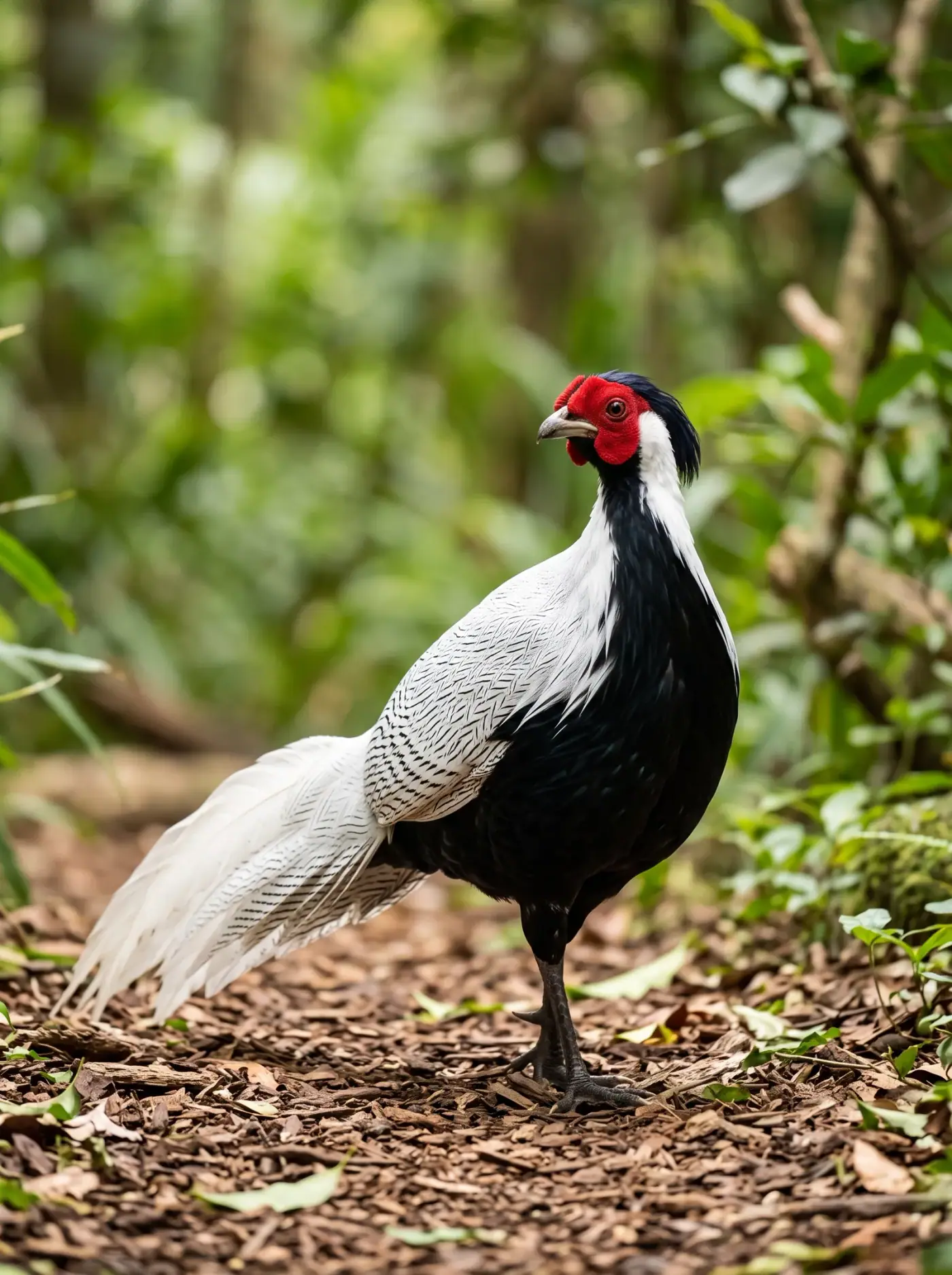
- A striking medium-sized pheasant with strong sexual dimorphism. The male has glossy blue-black underparts and a long black crest, while his upperparts and long tail are white marked with fine black lines; a bright red facial patch and crimson legs complete the look. Males can reach around 120 cm in total length (tail up to 75 cm) and weigh roughly 1.1-2 kg, while the camouflaged olive-brown female is smaller and shorter-tailed.
- Habitat
- Native to the mountain forests of mainland Southeast Asia and southern and eastern China, including Myanmar, Thailand, Vietnam and Hainan. It favours dense evergreen woodland and bamboo groves, typically at elevations between about 600 and 2,100 m.
- Diet
- An omnivorous ground-forager, it eats seeds, fruits, shoots and other plant matter, supplemented by insects and small invertebrates.
- Reproduction
- The hen lays a clutch of roughly 6-12 eggs in a nest hidden among vegetation, and incubation lasts about 23-25 days.
- Lifespan
- Around 5-8 years in the wild, and up to about 12 years under human care.
- Did you know?
- The male's contrasting silvery-white and blue-black plumage made this bird a prized ornamental species, and it is one of the parents of the naturally occurring hybrid known as the Imperial Pheasant.
Homeland & habitat
Where the silver pheasant lives
Spin the globe to see where the species comes from and where it lives today.
Southeast Asia and southern ChinaThe silver pheasant inhabits dense montane and submontane forests of Southeast Asia and southern China, from Myanmar and Thailand to the southern Chinese provinces.
Loading globe…
Native range
Drag to rotate · double-click to recentre on the homeland
10 facts about the silver pheasant
The cards keep rotating — hover with your mouse to pause them.
- GroupBirdsGalliformes (hrabaví) · Phasianidae (bažantovití)
- Scientific nameLophura nycthemeraLatin name of the species
- Homeland & habitatHusté tropické a subtropické lesy jihovýchodní Asie – Thajsko, Vietnam, Malajsie.
- DietSemena, plody, hmyz, drobní bezobratlí.
- Reproductionsnáší 6–12 vajec do hnízda mezi vegetací. Inkubace trvá 23–25 dní.
- LifespanV přírodě 5–8 let, v zajetí až 12 let.
- Conservation statusLeast ConcernAccording to the IUCN Red List
- Did you know…?Bažant stříbrný je ceněný pro kontrastní lesklé peří samec/samice
- Where in the zooArea A — aviaries and exhibits
- How many we keep♂ 1 · ♀ 1total: 2
Conservation status
Species vulnerability index
Least Concern
Near Threatened
Vulnerable
Endangered
Critically Endangered
LC – málo dotčený (Least Concern) podle IUCN – populace je stabilní.
Support the care of our animals
A symbolic adoption contributes to feeding, veterinary care and the development of the exhibits — and you get a certificate and updates about your animal.
Browse adoptions