Farm animals
Rouen
anas platyrhynchos f. domestica
Species originDomesticated
Rouen
- Description
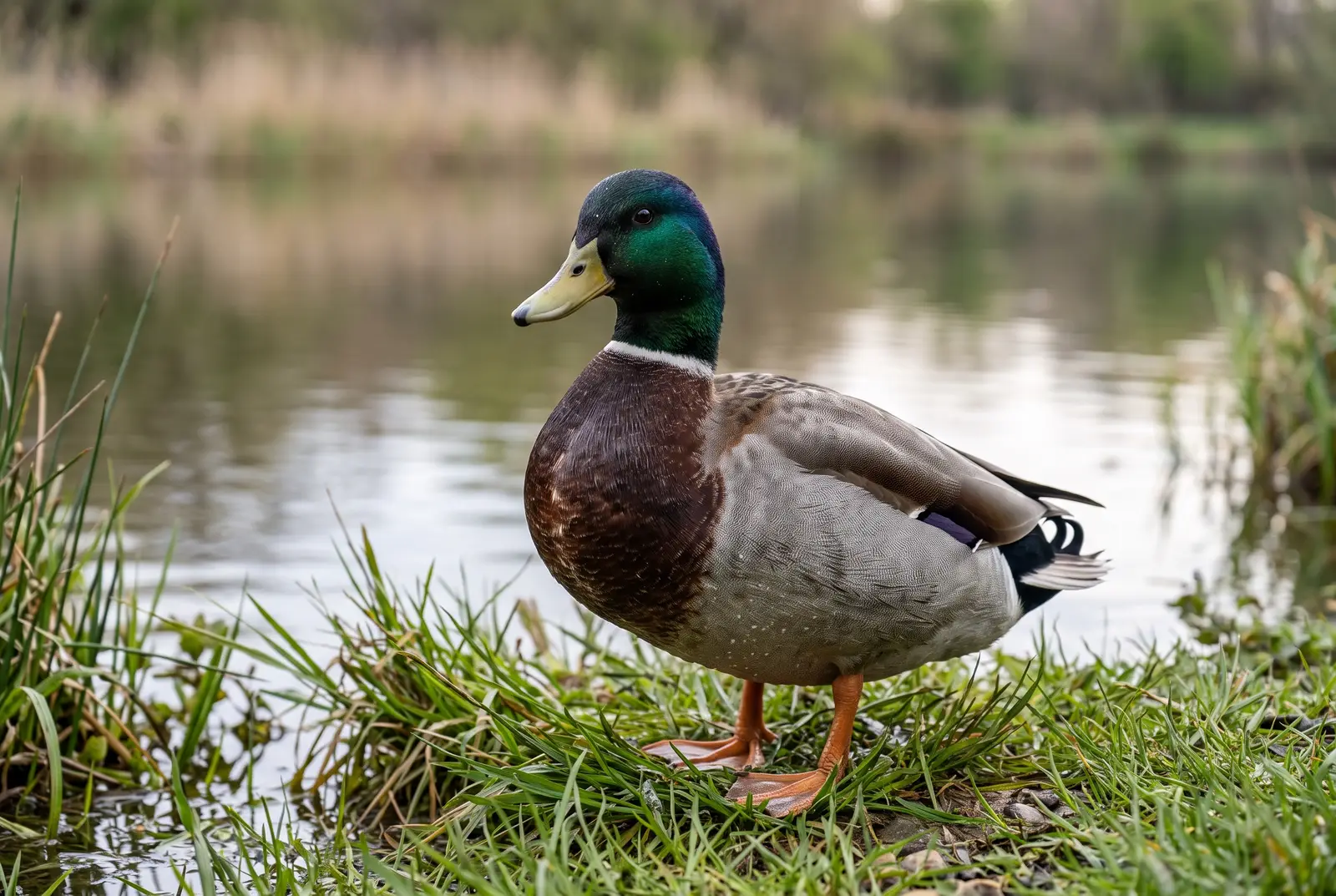
- The Rouen is one of the largest and heaviest breeds of domestic duck. Its plumage closely mirrors that of its wild ancestor, the mallard: the drake has a glossy green head, a white neck ring, a chestnut breast and a grey body, while the duck is a subtly barred brown with a blue wing speculum. Yet it is far more massive than the wild bird, with a deep, almost rectangular body; drakes commonly weigh 4–5 kg. Because of this bulk it is essentially flightless.
- Habitat
- As a domesticated breed it does not occur in the wild. It is kept on farms, smallholdings and in ornamental collections across Europe, favouring grassy runs with access to open water where it likes to paddle and forage.
- Diet
- It is omnivorous, grazing on grass and herbs, gathering seeds and grain, and sieving small animals from the water and its margins – insects and their larvae, molluscs, worms and snails. In captivity its diet is supplemented with cereals and greens.
- Reproduction
- It lays fewer eggs than utility breeds – roughly 35 to 150 a year depending on the strain – and incubates them for about 28 days. Exhibition-bred hens are often poor mothers, so the eggs are frequently hatched under a broody hen or in an incubator; the ducklings become independent soon after hatching.
- Lifespan
- With good care it lives about 8 to 12 years, occasionally longer.
- Did you know?
- There are two forms: the slimmer French 'Rouen clair', bred for production, and the massive, deep-bodied exhibition type perfected by English breeders in the 19th century. Although the drake looks like an oversized mallard, it can weigh up to three times as much and cannot take to the air.
Homeland & habitat
Where the rouen lives
Spin the globe to see where the species comes from and where it lives today.
France (Normandy)The Rouen is a heavy ornamental and utility breed of domestic duck that originated in the Rouen region of Normandy, France.
Loading globe…
Native rangeIntroduced / also today
Drag to rotate · double-click to recentre on the homeland
10 facts about the rouen
The cards keep rotating — hover with your mouse to pause them.
Support the care of our animals
A symbolic adoption contributes to feeding, veterinary care and the development of the exhibits — and you get a certificate and updates about your animal.
Browse adoptions