Primates
White-fronted brown lemur
eulemur albifrons
When to see us feeding
Primate feeding
Regular schedule outside weekend events
- Daily ·
10 October – 1 November 2026 · Open every day, 9:00–18:00, on weekdays and weekends. The special October programme takes place at weekends.
The regular feeding schedule continues on weekdays throughout October. On weekends from 10 October to 1 November, check the programme and the entrance for times.
Audio guide
Listen to the story of this animal
White-fronted brown lemur
- Description
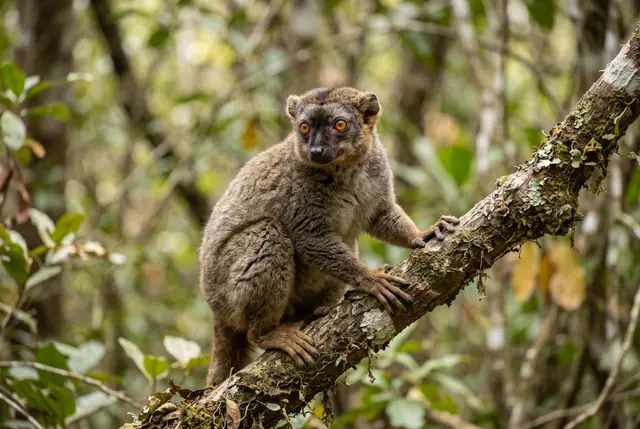
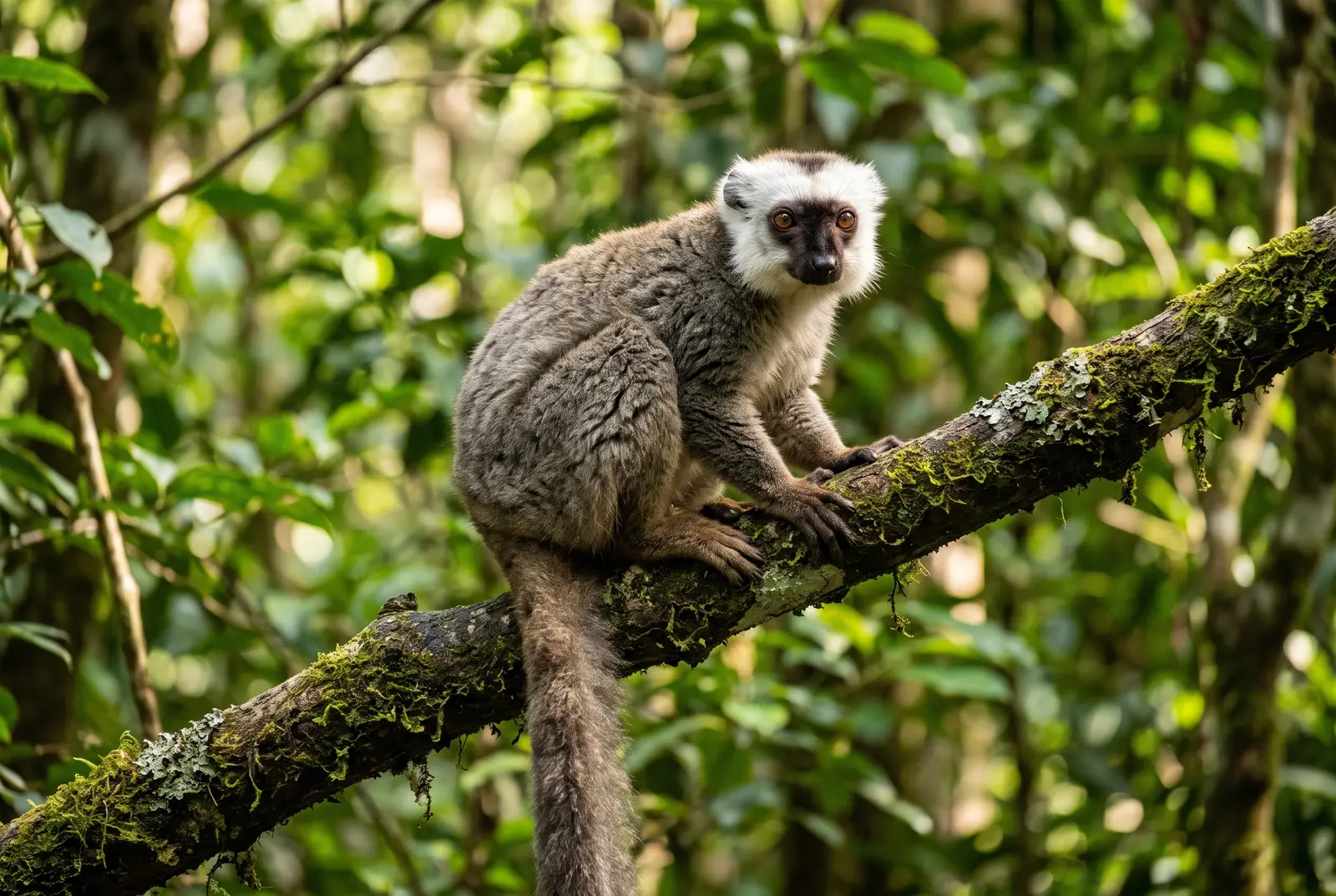
- The white-fronted brown lemur (also called the white-fronted lemur) is a medium-sized primate from Madagascar with striking sexual dichromatism. Males have a grey-brown body and a conspicuous white to cream head, white forehead and thick cheek whiskers, while females are uniformly brown with a greyish face and no white markings. Head and body measure about 40 cm, with a bushy tail adding a further 50 cm, and adults weigh around 2 kg. Agile among the branches, it uses its long tail as a rudder when leaping.
- Habitat
- Endemic to north-eastern Madagascar, where it lives in lowland and mid-altitude rainforest. It is highly arboreal and spends most of its time high in the forest canopy.
- Diet
- Predominantly frugivorous, feeding mainly on ripe fruit and supplementing this with leaves, flowers, nectar and seeds. It occasionally takes small invertebrates, and by drinking nectar it helps pollinate rainforest plants.
- Reproduction
- Gestation lasts about 120 days, after which the female usually gives birth to a single infant, occasionally twins. The young are born at the start of the rainy season and are carried first on the mother's belly and later on her back.
- Lifespan
- In the wild these lemurs live around 20 to 25 years, and individuals in human care can exceed 30 years.
- Did you know?
- It is cathemeral, active in bouts both day and night depending on the season and moonlight, a rhythm that is unusual among primates.
Homeland & habitat
Where the white-fronted brown lemur lives
Spin the globe to see where the species comes from and where it lives today.
North-eastern MadagascarThe white-fronted brown lemur is endemic to north-eastern Madagascar, living in the canopy of lowland and mid-altitude rainforests.
Drag to rotate · double-click to recentre on the homeland
10 facts about the white-fronted brown lemur
The cards keep rotating — hover with your mouse to pause them.
- GroupPrimatesPrimáti (Primates) · Lemurovití (Lemuridae)
- Scientific nameeulemur albifronsLatin name of the species
- Homeland & habitatEndemit severovýchodního Madagaskaru, kde obývá nížinné i horské deštné lesy. Je přísně stromový a většinu času tráví vysoko v korunách stromů.
- DietPřevážně plodožravec – základ potravy tvoří zralé plody, které doplňuje listy, květy, nektarem a semeny. Občas pozře i drobné bezobratlé a při pití nektaru pomáhá opylovat lesní rostliny.
- ReproductionBřezost trvá přibližně 120 dní, samice rodí zpravidla jedno mládě, méně často dvojčata. Mláďata přicházejí na svět na počátku období dešťů a matka je nejprve nosí na břiše, později na hřbetě.
- LifespanV přírodě se dožívá kolem 20–25 let, v lidské péči i přes 30 let.
- Conservation statusEndangeredAccording to the IUCN Red List
- Did you know…?Je katemérální – aktivní v kratších úsecích ve dne i v noci podle ročního období a svitu měsíce, což je mezi primáty vzácný rytmus.
- Where in the zooArea A + the new monkey pavilion
- How many we keep♂ 3 · ♀ 3total: 6
Conservation status
Species vulnerability index
Support the care of our animals
A symbolic adoption contributes to feeding, veterinary care and the development of the exhibits — and you get a certificate and updates about your animal.
Browse adoptionsWho you'll meet nearby
Full encyclopaedia