Birds
Galah
eolophus roseicapilla
IUCN Red ListLeast Concern
Audio guide
Listen to the story of this animal
0:000:00
Galah
- Description
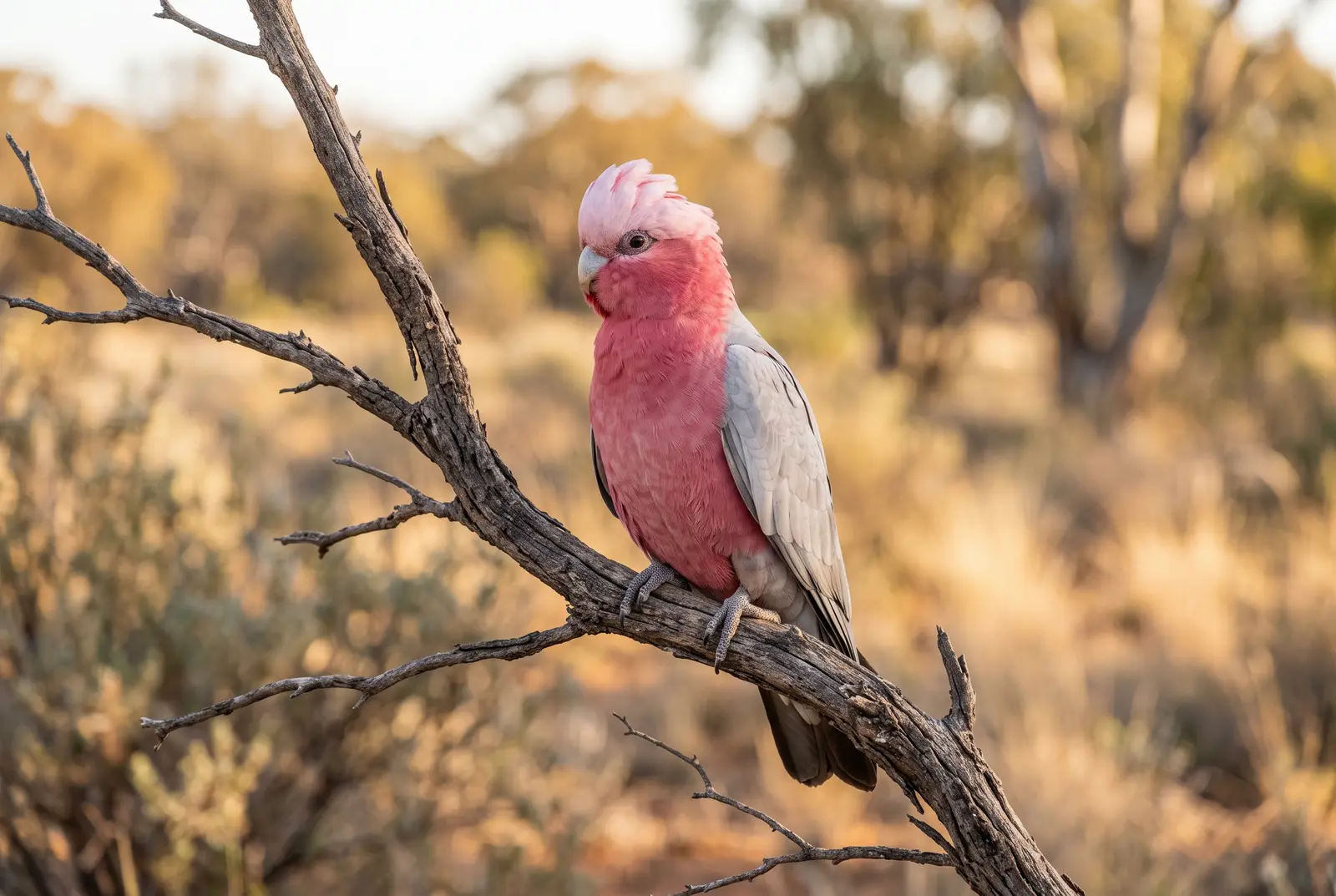
- The galah is a medium-sized cockatoo with unmistakable colouring: a deep rose-pink breast and underparts contrast with an ashy-grey back and wings and a pale pink, erectable crest. It grows to about 35 cm and weighs roughly 270–350 g. The sexes can be told apart by eye colour — males have a dark brown to almost black iris, while the females' eyes are pinkish red.
- Habitat
- It is found across virtually all of Australia, inhabiting open country, grassy plains, savanna, farmland and even city parks. Land clearing and the spread of crops and watering points have let it expand its range dramatically over the past century, and it is now one of Australia's most abundant parrots.
- Diet
- It feeds mainly on the seeds of grasses and herbs, together with grain and buds, foraging chiefly on the ground. In farming country it gathers in large flocks on sown fields, where it is often regarded as a pest.
- Reproduction
- It nests in tree hollows, which the pair lines with leaves. The female usually lays two to five white eggs, and both parents take turns incubating them for about 25 days. The chicks leave the nest after roughly seven to eight weeks.
- Lifespan
- In the wild it lives around 20–25 years, while in human care it commonly reaches 40 years or more, exceptionally over 70.
- Did you know?
- Galahs are extremely playful and sociable — they often hang upside down, slide along wires and perform wild aerial acrobatics during storms. In Australian slang the word "galah" even means a fool or a clown.
Homeland & habitat
Where the galah lives
Spin the globe to see where the species comes from and where it lives today.
AustraliaThe galah is found across virtually all of Australia, where in large flocks it inhabits open grassy plains, savanna and farmland.
Loading globe…
Native range
Drag to rotate · double-click to recentre on the homeland
10 facts about the galah
The cards keep rotating — hover with your mouse to pause them.
- GroupBirdsPapoušci · Kakaduovití
- Scientific nameeolophus roseicapillaLatin name of the species
- Homeland & habitatJe rozšířen prakticky po celé Austrálii, kde obývá otevřenou krajinu, travnaté pláně, savany, zemědělskou půdu i městské parky. Díky mýcení lesů a zakládání polí a napajedel svůj areál během posledního století výrazně rozšířil a dnes patří k nejhojnějším australským papouškům.
- DietŽiví se převážně semeny trav a bylin, obilím a pupeny, které sbírá hlavně na zemi. V zemědělské krajině se často slétá do velkých hejn na osetá pole, kde bývá považován za škůdce.
- ReproductionHnízdí v dutinách stromů, které si pár vystýlá lístky. Samice snáší zpravidla 2 až 5 bílých vajec, na nichž se v inkubaci trvající asi 25 dní střídají oba rodiče. Mláďata opouštějí hnízdo přibližně po sedmi až osmi týdnech.
- LifespanVe volné přírodě se dožívá zhruba 20–25 let, v lidské péči při dobré péči běžně 40 a více let, výjimečně i přes 70 let.
- Conservation statusLeast ConcernAccording to the IUCN Red List
- Did you know…?Kakadu růžoví jsou nesmírně hraví a společenští – často se houpou hlavou dolů, klouzají po drátech a za bouřek předvádějí divoké letecké kejkle. V australské hovorové angličtině dokonce slovo „galah“ označuje popletu či hlupáka.
- Where in the zooArea A — aviaries and exhibits
- How many we keep♂ 1 · ♀ 1total: 2
Conservation status
Species vulnerability index
Least Concern
Near Threatened
Vulnerable
Endangered
Critically Endangered
Support the care of our animals
A symbolic adoption contributes to feeding, veterinary care and the development of the exhibits — and you get a certificate and updates about your animal.
Browse adoptions