Birds
Indian peafowl
pavo cristatus
IUCN Red ListLeast Concern
Audio guide
Listen to the story of this animal
0:000:00
Indian peafowl
- Description
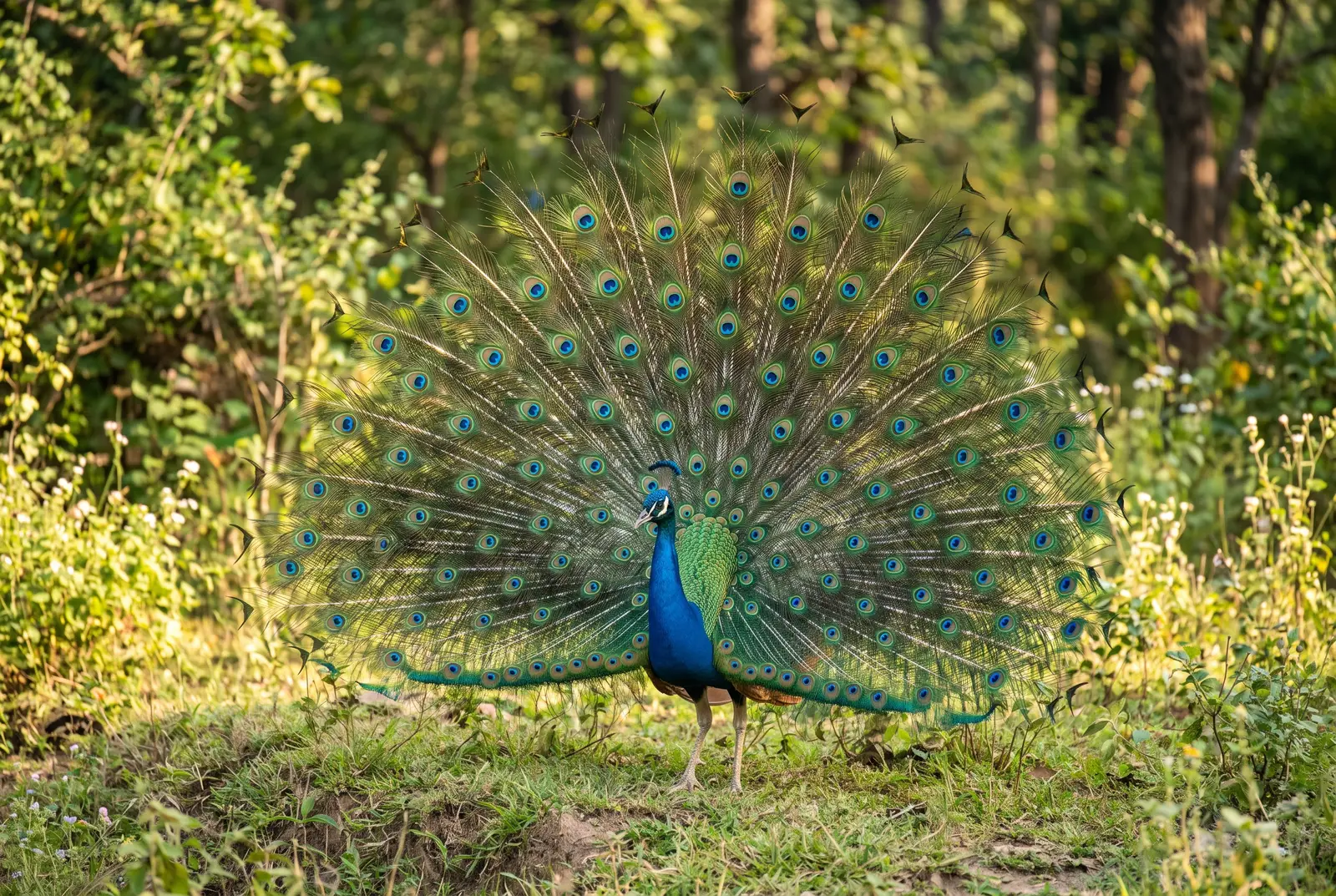
- The Indian peafowl is one of the largest and most spectacular members of the pheasant family. The male (peacock) is famous for his enormous 'train' of elongated upper tail coverts, adorned with dozens of iridescent eyespots, which he fans into a shimmering display during courtship. His neck and breast glow metallic blue and his head bears a fan-shaped crest, while the peahen is a mottled brown, smaller and without a train.
- Habitat
- Open and deciduous woodland, forest edges, scrub and farmland close to water across the Indian subcontinent, usually below about 2,000 m in altitude.
- Diet
- An omnivore that forages for seeds, grain, shoots, fruit and berries as well as insects, small reptiles including small snakes, and other small animals.
- Reproduction
- Peafowl are polygynous: a single male mates with several females that he attracts by displaying his raised train. The peahen lays 3–6 eggs in a simple ground nest and incubates them alone for about 28 days; the chicks are downy and follow their mother soon after hatching.
- Lifespan
- Around 15–20 years in the wild and often over 20 years under human care.
- Did you know?
- The glittering 'eyes' of the train are produced by light bouncing off microscopic feather structures rather than by pigment, and the train itself is not the tail but overgrown covert feathers that regrow after each annual moult. The species is also the national bird of India.
Homeland & habitat
Where the indian peafowl lives
Spin the globe to see where the species comes from and where it lives today.
Indian subcontinentThe Indian peafowl is native to the open woodlands and farmland of the Indian subcontinent and Sri Lanka, from where it has been introduced worldwide as an ornamental bird.
Loading globe…
Native rangeIntroduced / also today
Drag to rotate · double-click to recentre on the homeland
10 facts about the indian peafowl
The cards keep rotating — hover with your mouse to pause them.
- GroupBirdsHrabaví (Galliformes) · Bažantovití (Phasianidae)
- Scientific namepavo cristatusLatin name of the species
- Homeland & habitatOtevřené a řídké lesy, jejich okraje, křoviny a zemědělská krajina v blízkosti vody na indickém subkontinentu, obvykle do nadmořské výšky kolem 2000 m.
- DietVšežravec. Sbírá semena, obiloviny, výhonky, plody a bobule, ale i hmyz, drobné plazy včetně malých hadů a menší obratlovce.
- ReproductionŽije polygamně – jeden samec se páří s několika samicemi, které si získává tokem s rozevřenou vlečkou. Pávice snáší 3–6 vajec do jednoduchého hnízda na zemi a sama je zahřívá asi 28 dní. Mláďata jsou po vylíhnutí opeřená a brzy následují matku.
- LifespanV přírodě zpravidla 15–20 let, v lidské péči se dožívá i přes 20 let.
- Conservation statusLeast ConcernAccording to the IUCN Red List
- Did you know…?Barevná „oka“ na vlečce nevznikají pigmentem, ale lomem světla na mikroskopické struktuře per; vlečka navíc není ocas, nýbrž prodloužené krovky, které se po každém přepeření znovu obnoví. Páv korunkatý je zároveň národním ptákem Indie.
- Where in the zooArea A — aviaries and exhibits
- How many we keep♂ 1 · ♀ 6 · 4 youngtotal: 11
Conservation status
Species vulnerability index
Least Concern
Near Threatened
Vulnerable
Endangered
Critically Endangered
Support the care of our animals
A symbolic adoption contributes to feeding, veterinary care and the development of the exhibits — and you get a certificate and updates about your animal.
Browse adoptions