Birds
Demoiselle Crane
Anthropoides virgo
Audio guide
Listen to the story of this animal
0:000:00
Demoiselle Crane
- Description
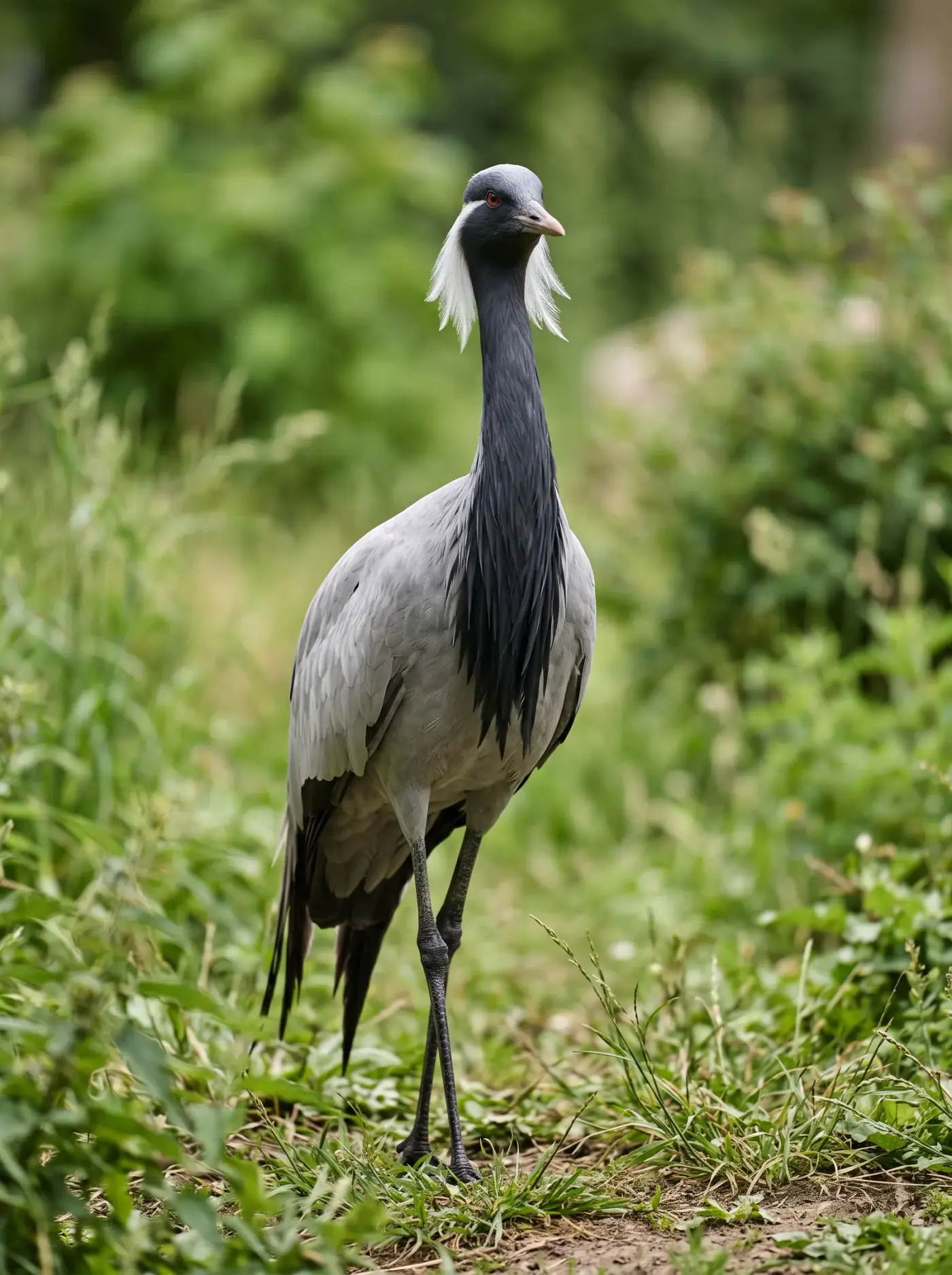
- The demoiselle crane is the smallest of all crane species, standing 85–100 cm tall with a wingspan of roughly 155–185 cm and weighing about 2–3 kg. It has an elegant, slender build with a pale blue-grey body, a black neck and breast that trail into a long plume, and delicate white feather tufts sweeping back from behind each eye. Males have blood-red eyes, while those of females are more orange.
- Habitat
- It breeds in the open steppes and semi-deserts of south-eastern Europe, Central Asia, Mongolia and northern China, favouring dry grassland near water and avoiding wetlands. In winter the birds migrate south to the Indian subcontinent, sub-Saharan Africa (Ethiopia, Sudan and Chad) and the Middle East.
- Diet
- The demoiselle crane is omnivorous but more strongly plant-eating than other cranes, feeding mainly on grass seeds, cereal grains and green plant parts. It supplements this with insects such as grasshoppers, and occasionally small invertebrates and other tiny animals.
- Reproduction
- Pairs are monogamous and typically stay together for life. The female usually lays two eggs, which both parents take turns incubating for about 27–29 days. The chicks are precocial, following their parents soon after hatching and fledging at around 55–65 days.
- Lifespan
- In the wild these cranes live around 20 years, while in human care they may reach over 30 years.
- Did you know?
- On migration, demoiselle cranes make one of the most demanding journeys of any bird, flying over the towering peaks of the Himalayas; in India they are traditionally regarded as sacred.
Homeland & habitat
Where the demoiselle crane lives
Spin the globe to see where the species comes from and where it lives today.
Eurasian SteppesBreeds in the steppes and semi-deserts from southeastern Europe across Central Asia to Mongolia and northern China, wintering in India, northeastern Africa and the Middle East.
Loading globe…
Native rangeIntroduced / also today
Drag to rotate · double-click to recentre on the homeland
9 facts about the demoiselle crane
The cards keep rotating — hover with your mouse to pause them.
- GroupBirdskrátkokřídlí (Gruiformes) · jeřábovití (Gruidae)
- Scientific nameAnthropoides virgoLatin name of the species
- Homeland & habitatHnízdí v stepích a polopouštích jihovýchodní Evropy, Střední Asie, Mongolska a severní Číny. Vyhýbá se mokřadům. Zimuje v Indii, Africe (Etiopie, Súdán, Čad) a na Blízkém východě.
- DietJe všežravý, ale výrazněji rostlinožravý než jiné jeřáby: semena trav, obilí, zelené části rostlin, hmyz, kobylky, drobní obratlovci v menší míře.
- Reproductionpáry jsou monogamní a zůstávají spolu po celý život. Snůška 2 vajec, na kterých střídavě sedí oba rodiče. Mládě je nidifugní a brzy po vylíhnutí následuje rodiče.
- LifespanVe volné přírodě kolem 20 let, v zajetí může žít i přes 30 let.
- Did you know…?V Indii je považován za posvátného ptáka.
- Where in the zooArea A — aviaries and exhibits
- How many we keep♂ 1 · ♀ 1total: 2
Support the care of our animals
A symbolic adoption contributes to feeding, veterinary care and the development of the exhibits — and you get a certificate and updates about your animal.
Browse adoptions